
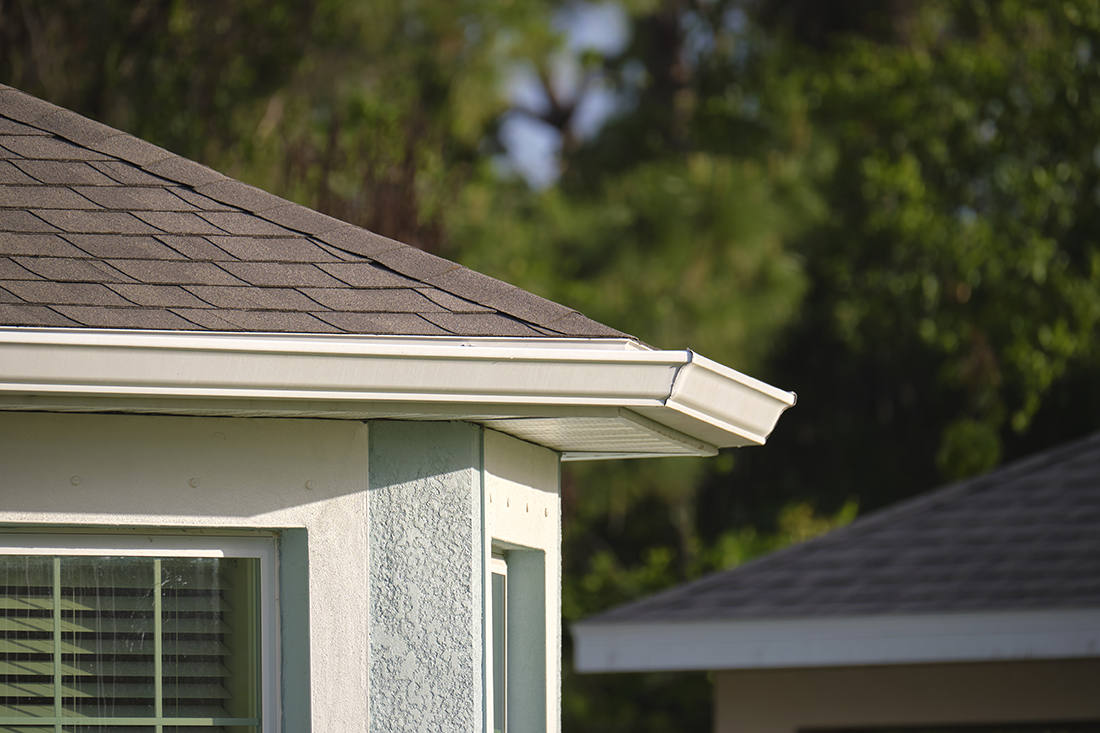
Rainwater management is one of the invisible aspects of property management that usually only gets attention when something goes wrong. Both for commercial and residential buildings, the primary goal of a gutter system is simple: to catch rainwater as it leaves the roof and direct it safely away from the foundation.
The way that we achieve that goal has evolved significantly over thousands of years, from ancient stone channels to the efficient seamless gutters you can find today. For decades, property owners relied on sectional gutters, pieced together from standard lengths. But today, more people are choosing seamless gutters in OKC.
The Era of Sectional Gutters
For much of the mid-20th century, standard residential and commercial properties relied almost exclusively on sectional gutters. These traditional systems were mass-produced in standardized lengths, typically 10’ or 20’ sections. They were packaged in hardware stores and assembled by hand on-site.
Installers would overlap the edges of these segments, sealing them with specialized caulking or sealants. Then they’d secure them together with pop rivets or slip-joint connectors.
Sectional gutters made DIY installation accessible and provided a functional baseline for diverting water away from a building, but they also possessed an inherent vulnerability: joints. Over the course of a single year, buildings experience significant thermal cycling. Fluctuating outdoor temperatures cause metals like aluminum and galvanized steel to expand during hot summer days and contract during winter nights.
This movement puts major stress on sealed joints. Eventually, the sealants crack, dry out, and separate. When this occurs, gaps are created where water can escape before it reaches downspouts. These leaks can actually go completely unnoticed for a long time- until they start staining exterior walls, causing structural timber to rot, or pooling dangerously close to the building’s foundation.
The Invention of Seamless Gutters
To address the maintenance issues caused by joint failure, the industry introduced continuous aluminum gutter systems around the 1960s. This innovation completely eliminated the weak points that were inherent in pieced-together sectional gutter systems.
Instead of piecing together pre-cut segments, seamless gutters use continuous rolls of heavy-gauge aluminum that’s fed directly into a portable roll-forming machine. The machine is brought straight to the job site, and uses a series of rollers to bend the flat metal sheet into a continuous profile, like a K-style or box gutter. This profile is custom-measured to the exact millimeter dimensions of the structure’s roofline.
Because the material is unbroken from end to end, the only joints that actually remain are at the corners and end caps. These corner joints, which are necessary for the gutter system’s construction, are heavily reinforced and sealed away from straight runs. Every precaution is taken to reduce the potential for water leaks across the property.
Why are Joint-Free Systems an Upgrade for Your Home?
Removing dozens of seams eliminates the primary failure points that are prone to leaking, sagging, and fastener separation under potentially heavy loads of debris and water.
Use high-quality aluminum, combined with a continuous structure. This prevents warping and handles a high volume of water flow efficiently without bowing. Seamless gutter systems actually prevent fascia rot, too. Sectional gutter systems have the potential to leak and saturate underlying wooden elements. Continuous runs keep water inside the channel so it doesn’t touch the fascia board.
With sectional gutters, water that escaped could drop straight down along the perimeter of the structure. This water could erode soil and eventually compromise concrete foundations or basement walls. Seamless systems direct the water safely toward designated downspout exits, away from the foundation.
The Best Option for Your Property
When evaluating options for seamless gutters in OKC, property owners weigh upfront configuration against long-term maintenance needs. While traditional sectional gutter systems are still an option, they’re best for temporary fixes or specific budget constraints. Continuous, seamless gutters offer a structurally sound solution that prevents leaks, reduces long-term repair costs, and keeps building materials preserved.
We’re happy to answer any questions you might have about the building process or the benefits of a seamless gutter system. Give us a call today to get a free estimate!